
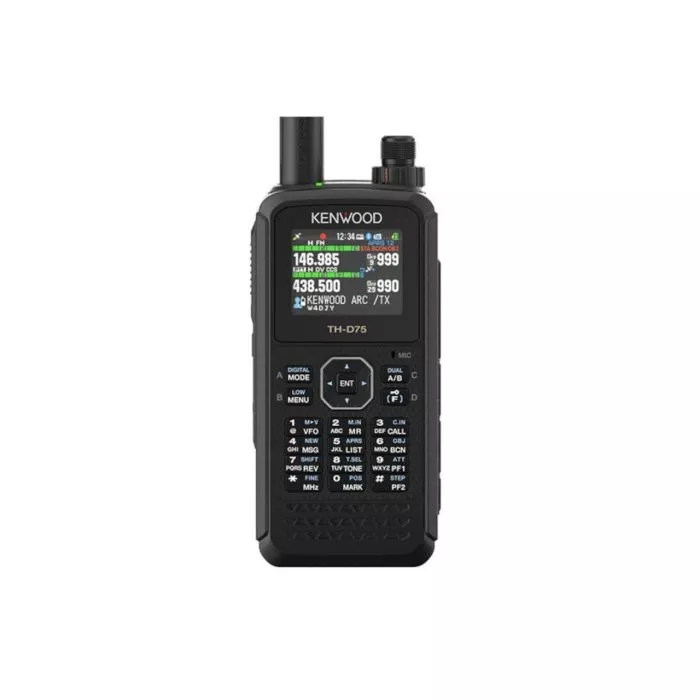
The Kenwood TH-D75 is not merely a successor to the TH-D74; it is a ground-up modernization of Kenwood’s flagship handheld architecture. Designed for operators who actively use APRS, D-STAR, wideband receive, and advanced signal monitoring, the TH-D75 integrates RF performance, digital processing, and modern I/O in a way few HTs currently match.
This article focuses on the radio architecture, DSP chain, digital subsystems, and operational implications rather than marketing features.
RF Architecture and Band Coverage
Transmit Capabilities
The TH-D75 is a true tri-band HT:
| Band | Frequency Range | Typical Output |
|---|---|---|
| VHF | 144–148 MHz | ~5 W |
| 1.25 m | 222–225 MHz | ~5 W |
| UHF | 430–450 MHz | ~5 W |
Unlike many radios that include 220 MHz as an afterthought, the TH-D75 provides full-power, fully supported 1.25 m operation, making it especially valuable in regions where 220 MHz repeaters are active.
Receiver Design
The receiver uses a direct-conversion / DSP-centric architecture with strong adjacent-channel rejection and clean audio recovery. Compared to typical budget HTs, desense resistance is notably better when operating near high-RF environments or multi-radio field deployments.
Wideband receive coverage includes:
- HF (SSB/CW/AM receive only)
- VHF/UHF public service and aviation
- Broadcast FM
- Marine VHF
While HF reception is limited by antenna efficiency, the inclusion of SSB demodulation is technically significant and useful when paired with an external antenna or for monitoring strong signals.
Digital Signal Processing (DSP)
Kenwood’s DSP implementation is one of the TH-D75’s strongest technical assets.
Audio DSP Features
- Digital noise reduction
- Adjustable filtering
- Consistent audio recovery across analog FM and D-STAR
- Improved speaker amplifier and enclosure tuning versus prior models
The result is cleaner recovered audio at lower signal levels, particularly noticeable on weak FM simplex and D-STAR signals.
APRS Subsystem (Native, Not Emulated)
Kenwood continues to set the benchmark for native APRS implementation, and the TH-D75 expands on this legacy.
APRS Hardware Stack
- Integrated GPS receiver
- Dedicated APRS modem and TNC
- No smartphone or external TNC required
- microSD logging for packets and tracks
APRS Functional Depth
- Position reporting with smart beaconing
- Messaging (full keyboard entry via UI)
- Object and weather decoding
- Stand-alone digipeater mode
- KISS-compatible data workflows (via USB)
From a systems perspective, this is true embedded APRS, not an application layered on top of a voice radio. For operators running APRS on foot, mobile, or as part of an emergency kit, this distinction matters.
D-STAR Implementation
The TH-D75 supports D-STAR DV and DD features, with several advanced operational modes:
- Dual D-STAR receive
- Reflector Terminal Mode (network-linked operation without RF gateway)
- Gateway access via internal networking logic
- Call routing and monitoring tools integrated into UI
While D-STAR is not universal, Kenwood’s implementation is among the most complete available in a handheld, particularly for operators already invested in Icom/Kenwood D-STAR ecosystems.
I/O, Control, and Integration
USB-C Interface
- Charging
- Audio (digital sound device)
- CAT/control
- Data (APRS, logging, firmware)
USB-C significantly simplifies digital workflows, including packet/APRS interfacing and firmware maintenance.
Bluetooth
- Hands-free audio
- Wireless control accessories
- Field and mobile operation enhancements
Storage
- microSD card for:
- APRS logs
- GPS tracks
- Configuration backups
- Firmware updates
This supports repeatable deployments, especially valuable for operators who maintain multiple radios or standardized field profiles.
Power System and Thermal Considerations
- Lithium-ion battery pack
- Typical operating life: ~6–8 hours with GPS/D-STAR active
- Thermal performance is well-managed; sustained digital transmissions do not cause aggressive power fold-back
For extended deployments, spare batteries or external USB power are recommended—particularly for APRS-heavy usage.
Build Quality and Ergonomics
Kenwood’s mechanical design emphasizes:
- Solid chassis and RF shielding
- Weather-resistant construction
- Logical control layout
- High-contrast TFT display readable in daylight
The radio feels engineered rather than cost-optimized—a noticeable distinction from many contemporary HTs.
Comparative Technical Positioning
From a purely technical standpoint, the TH-D75 sits in a different class than most handhelds:
- More capable APRS than smartphone-paired radios
- Cleaner RF and DSP than budget HTs
- Better tri-band implementation than most competitors
- Deeper native digital integration than add-on solutions
It is not designed to compete on price; it competes on capability density per cubic inch.
Final Technical Assessment
The Kenwood TH-D75 is best described as a portable digital communications platform, not simply a handheld transceiver. Its architecture favors operators who actively use:
- APRS as an operational tool
- D-STAR for networked digital voice
- Wideband monitoring
- Field-deployable, self-contained systems
For technically inclined amateurs—especially those running APRS nodes, go-kits, or mixed digital/analog workflows—the TH-D75 remains one of the most technically complete HTs available today.