
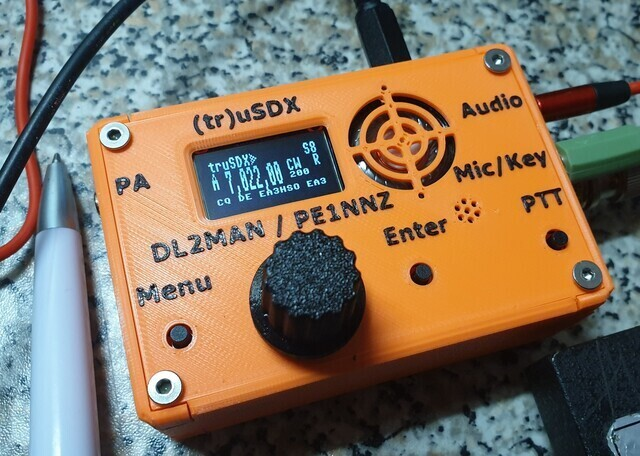
The (tr)uSDX is one of the most compelling examples of how open-source design, modern microcontrollers, and classic QRP philosophy can converge into a highly capable HF transceiver. Designed as a compact, low-power, multi-mode radio, the (tr)uSDX targets operators who value efficiency, portability, and experimentation without sacrificing real on-air performance.
Originally inspired by minimalist SDR concepts and homebrew traditions, the (tr)uSDX has evolved into a mature platform that is equally at home on a summit, in the field, or on a crowded desk as a secondary HF rig.
Core Capabilities at a Glance
Despite its small footprint, the (tr)uSDX delivers functionality that rivals much larger radios:
- HF Coverage: Typically 80–10 meters (variant-dependent)
- Modes: SSB, CW, AM, FM (band and firmware dependent)
- Output Power: ~5 watts QRP
- Architecture: Direct conversion with SDR-style DSP
- Display: Compact OLED with spectrum/waterfall elements
- Power: 5–12 VDC (battery-friendly)
- Firmware: Actively developed, open-source
This feature set makes the (tr)uSDX particularly attractive for operators who enjoy both operating and understanding what is happening under the hood.
Design Philosophy: Efficiency and Transparency
What sets the (tr)uSDX apart is not just what it does, but how it does it.
The radio leverages modern microcontrollers to handle DSP tasks that once required bulky analog stages or dedicated DSP chips. Much of the signal processing—including filtering, modulation, and demodulation—is performed in software. This approach keeps the hardware simple while allowing continuous improvement through firmware updates.
For technically inclined operators, this transparency is a major advantage. The signal chain is well documented, the firmware is readable, and experimentation is encouraged.
Receiver Performance
In real-world operation, the (tr)uSDX receiver performs remarkably well for a QRP-class radio:
- Clean audio with configurable DSP filters
- Adjustable AGC behavior
- Effective noise reduction for weak-signal work
- Usable dynamic range for casual contesting and portable operation
While it does not aim to compete with full-size contest-grade SDRs, its performance is more than sufficient for SSB ragchews, CW DX, and digital-adjacent monitoring.
Transmit Audio and SSB Quality
One of the most discussed aspects of the (tr)uSDX is its SSB transmit quality. Early designs earned a reputation for being “good for QRP but picky,” and ongoing firmware refinements have significantly improved audio shaping and linearity.
With proper microphone gain and compression settings, the radio produces clean, intelligible SSB audio that holds its own in pileups—especially considering the 5-watt output class.
CW operation is crisp and stable, making the (tr)uSDX a favorite among portable CW enthusiasts.
Portability and Field Use
This is where the (tr)uSDX truly shines.
- Lightweight and compact enclosure options
- Low current draw, ideal for LiFePO₄ and USB-boosted battery packs
- Minimal accessory requirements
- Quick setup for POTA, SOTA, and emergency deployments
Paired with an efficient antenna—such as an end-fed half-wave or resonant dipole—the radio is capable of impressive distances under favorable conditions.
Open-Source Ecosystem
The (tr)uSDX benefits from an active and technically sophisticated community. Firmware updates regularly introduce:
- Improved DSP algorithms
- Additional band support
- UI refinements
- Stability and performance enhancements
This ecosystem ensures that the radio continues to improve long after purchase or assembly, a rarity in the commercial amateur radio market.
Who the (tr)uSDX Is For
The (tr)uSDX is an excellent choice if you:
- Enjoy QRP operating and portable HF
- Appreciate open-source hardware and firmware
- Want a capable secondary or field radio
- Like experimenting with DSP and RF concepts
It may not be ideal if you require high-power output, integrated automatic tuners, or advanced digital-mode USB audio without additional interfaces.
Final Thoughts
The (tr)uSDX represents the spirit of modern amateur radio: compact, efficient, transparent, and community-driven. It rewards operators who are willing to learn its strengths, understand its limitations, and take advantage of its flexibility.
For QRP operators, portable enthusiasts, and technically curious hams, the (tr)uSDX is more than just a radio—it is a platform for exploration, learning, and surprisingly effective HF operation from almost anywhere.